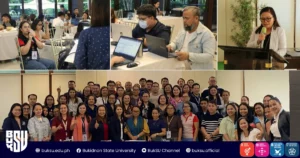
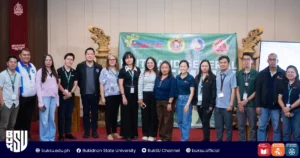
Experts and academic leaders called for a strategic shift in national policy to better integrate indigenous lived practices into the country’s development and conservation frameworks during a high-level forum at the 12th Socioeconomic Research Portal for the Philippines (SERP-P) Knowledge-Sharing Forum, co-hosted by Bukidnon State University (BukSU) and the Polytechnic University of the Philippines (PUP) on March 11, 2026.
The forum emphasized the role of Indigenous Cultural Communities (ICCs) in nation-building and environmental stewardship.
Dr. Philip Arnold P. Tuaño, President of the Philippine Institute for Development Studies (PIDS), highlighted that the event’s location in Bukidnon was a deliberate move to decentralize policy conversations. He noted that with nearly 9 million Filipinos identifying as Indigenous Peoples, their centuries-old wisdom regarding environmental care and conflict resolution is more relevant than ever to modern society.
“Inclusive development can only happen when a wide range of voices are heard, respected, and included in policy and practice,” stated Dr. Manuel M. Muhi, President of PUP, in his closing remarks.
A central theme of the forum was the relationship between environmental mandates and indigenous rights. Dr. Sonny N. Domingo of PIDS presented research showing that approximately 1.44 million hectares of Certificate of Ancestral Domain Titles (CADTs) overlap with protected areas.
He argued that for conservation to be truly effective, indigenous leaders must be central architects of management boards rather than mere consultants. Dr. Domingo recommended harmonizing the Indigenous Peoples’ Rights Act (IPRA) with environmental laws to protect critical biodiversity while respecting indigenous stewardship.
Indigenous leader Hon. Adelina Tarino “Bae Inatlawan,” representing the Bukidnon-Daraghuyan Tribe, shared firsthand insights on ancestral domain stewardship. She emphasized that their governance is rooted in ancestral laws and spiritual guidance, with knowledge derived from nature and passed down through generations reinforcing the importance of Indigenous wisdom in environmental protection and community resilience.
Other presentations explored environmental governance under the NIPAS and E-NIPAS frameworks, cultural preservation among the Iraya Mangyan, and the integration of Indigenous sustainability practices into urban development. These studies highlighted the need for stronger policy alignment, particularly to address overlapping land claims, strengthen Indigenous participation, and recognize traditional ecological knowledge as vital to national development.
The forum also explored how indigenous communities can thrive economically through social entrepreneurship. Prof. Loreta Sol L. Dinlayan of BukSU introduced the concept of the “5th Pillar” of sustainability: Customary Practice.
Studying the Bukidnon-Tagoloanon tribe’s cooperative, BUKTAMACO, Prof. Dinlayan suggested that the Philippine Cooperative Code (R.A. 9520) should be revisited to recognize traditional governance structures. She explained that by integrating indigenous leadership and communal values, the nation can create social enterprises that are both culturally resilient and financially viable.
Other presentations focused on the spiritual and cultural dimensions of indigenous life. Dr. Judith C. Singcolan (BukSU) documented the Kahusayan Hu Lidu, a peace ritual of the Talaandig tribe that serves as a restorative justice mechanism.
Through the Kahusayan Hu Lidu (Peace Ritual), the tribe maintains harmony with the supreme being, Magbabaya, and the spirits of the environment. From the Panalabugta (respect for the soil) to the Panalawahig (thanksgiving for water), every interaction with nature is a ritual of seeking permission. This “spiritual ecology” acts as a natural check against greed and environmental destruction, offering a model of stewardship that modern society has long forgotten.
Prof. Werlie Bueno and Prof. Diosdado Franco of PUP shared insights from the Iraya Mangyan of Mindoro, arguing that indigenous sustainability principles such as collective governance and spiritual ecology can inform modern urban development.
Prof. Werllie P. Bueno explored the fragile identity among the Iraya Mangyan. For the elders of this tribe, identity is a practice embedded in the maráyaw (ritual chants), traditional crafts, and games.
Her research emphasized that centering the voices of elders is an ethical imperative. Preserving these cultural expressions is about sustaining a living heritage that offers meaning, dignity, and directio to the younger generation as they navigate a globalized world.
Prof. Diosdado P. Franco provided the bridge between the forest and the city. He argued that the lived experiences of the Iraya Mangyan offer vital lessons for urban development, which currently prioritizes speed and technical efficiency over community and ecology.
Key concerns raised during the roundtable included delays in issuing Certificates of Ancestral Domain Titles (CADTs), gaps in data systems affecting Indigenous communities, and the need to reconcile formal governance structures with customary leadership systems. Participants also emphasized food security, infrastructure development, and culturally responsive education as priority areas for intervention.
Central to the discussion was a shared commitment to advancing actionable policy recommendations. These include accelerating CADT processing, improving Indigenous data systems, integrating customary governance into formal institutions, and strengthening community-based approaches to food security and education. (Eunssj C. Escalona/Head-CPS, and Menard Labor/IU intern)