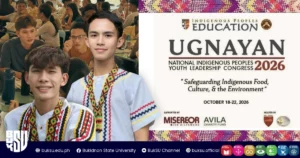
Two Bukidnon State University (BukSU) Community Development students represented the Higaonon community at the National Indigenous Peoples Youth Leadership Congress (UGNAYAN 2026), held in Sitio Masla, Barangay Sablang, Quezon Province, from October 18 to 22, 2026.
James Bond V. Noval and Christian Mark A. Sebusa, both Higaonon youth from Malaybalay City, Bukidnon, joined delegates from Indigenous communities nationwide to discuss the preservation of ancestral domains, traditional food systems, and cultural heritage.
As someone who is privileged, representing my community as a Higaonon at UGNAYAN 2026 was both an honor and a meaningful responsibility, with a heart filled with gratitude. One of the most important lessons I learned from UGNAYAN 2026 that I want to share with my fellow Higaonon Youth is that preserving our culture is living it and passing it on to the next generation,” Noval said.
“As a young Indigenous person, UGNAYAN 2026 reminded me that we are the stewards and guardians who are responsible for keeping it alive. I want to encourage my fellow Higaonon youth to take pride in who we are, listen to and learn from our elders, practice our traditions, preserve our Indigenous Knowledge Systems and Practices, and actively participate in protecting our ancestral domains. We must not wait until our traditions are forgotten or our natural resources are lost before we recognize their value,” he added.
The four-day congress, organized by the Assisi Development Foundation Inc. (ADFI), carried the theme “Safeguarding Indigenous Food, Culture, and the Environment.”
The congress featured discussions on environmental threats to ancestral domains and the role of Indigenous youth in conserving native seeds, protecting biodiversity and sustaining traditional livelihoods.
Resource speaker Robert Cahapun (Takurug Ki) of the Manobo community discussed the need to preserve native seeds and promote sustainable livelihoods. He also addressed how Indigenous youth can use technology to document and protect their heritage.
Representatives from MASIPAG (Magsasaka at Siyentipiko para sa Pag-unlad ng Agrikultura) led sessions on the Slow Food movement and sustainable agriculture. Discussions covered the role of native seeds in preserving ancestral agricultural knowledge and maintaining crop diversity.
Instructors said youth participation is necessary to help prevent the loss of traditional crop varieties.
“As a present generation, I must value and safeguard our ancestral land, forest, river, and natural resources because these are part of my identity as a Higaonon. These are part of our culture and our source of life. These resources, especially our ancestral land, we consider as our hospital, because it provides us with traditional medical plants that cure illnesses among members of the community. That’s why these resources are important in our life and must be protected,” Sebusa said.
“As a Higaonon youth, I must remember that our culture is my identity, our ancestral land is my life, our GAGAW (love) is my strength. Through the connection between elders and the youth, we can ensure that our culture and ancestral land will continue to live for future generations,” he emphasized.
Noval and Sebusa joined youth representatives from Tagakolu, Dumagat, Manobo, and other Indigenous communities in activities that included field exchanges on local ecosystems and biodiversity, with community guides providing information about the surrounding environment.
Dumagat elders from Sitio Masla opened the congress with sacred rituals and storytelling. The sessions discussed how Indigenous culture is expressed through daily language, agricultural practices and community life, in addition to traditional attire and cultural performances.
The program also featured an Indigenous Food Festival, where participants presented traditional dishes from their respective communities. Among the featured foods was “Tasak and Lusuk,” a root crop delicacy from the Tagakolu community.
The festival connected traditional food preparation with biodiversity conservation and community identity.
Cultural nights and interactive workshops provided opportunities for delegates to share their traditions and discuss the role of younger generations in preserving Indigenous knowledge.
According to Dr. Jose Benito C. Ronolo, Department Head of the Community Development Department, the participation of Noval and Sebusa in UGNAYAN 2026 proves that Community Development education succeeds when it produces culturally aware, socially responsible practitioners who walk alongside Indigenous communities as equal partners in sustainable development.
“The program (Bachelor of Science in Community Development) advocates respect for diverse cultures, races, beliefs, and Indigenous Peoples (IP) communities by providing students with opportunities to participate in activities that recognize and celebrate their cultural heritage. Through these experiences, students become more aware of the importance of preserving Indigenous knowledge, protecting ancestral domains, and respecting the rights and traditions of Indigenous communities,” Ronolo shared. “Their participation reflects the program’s commitment to developing socially responsible and culturally sensitive community development practitioners who recognize Indigenous Peoples not merely as beneficiaries of development, but as active partners and decision-makers in preserving their heritage, protecting their ancestral lands, and advancing the well-being of their communities,” he added.
Organizers said the congress provided a platform for young Indigenous leaders to address environmental and cultural pressures affecting their communities.
At the end of the congress, the youth delegation issued a collective declaration: “May our generation be the last one, not the lost one.” The statement expressed the delegates’ commitment to passing ancestral knowledge to future generations and preventing the loss of Indigenous cultural heritage. (With information from James Bond V. Noval and Christian Mark A. Sebusa, BS Community Development students)