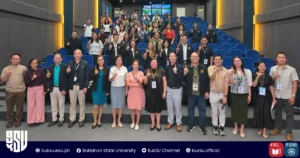
Eighty-four faculty members and extension staff from Bukidnon State University (BukSU) completed a two-day training on the Harmonized Gender and Development Guidelines (HGDG) on October 1, 2026, at Loiza’s Pavilion to enhance the gender responsiveness of university extension programs.
Organized by the Extension Services and Community Engagement Unit (ESCEU) under the Office of the Vice President for Research, Extension and Innovations (OVPREI), in partnership with the University Gender Research and Resource Center (UGRRC), the workshop gathered 60 female and 24 male project leaders and extensionists across BukSU’s seven colleges and 16 satellite campuses.
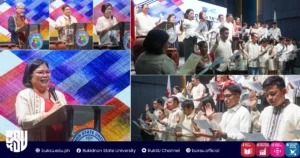
University President Dr. Joy M. Mirasol emphasized that gender integration must be embedded into the core of community engagement under BukSU’s Smart BukSU and BULIG frameworks.
“Are the benefits reaching women, men, and different sectors of the community in ways that respond to their actual needs?” Mirasol asked participants. “Gender responsiveness must be part of how we plan and deliver our extension programs from the beginning, not something we simply add at the end.”
Led by Dr. Shaunell Mary J. Sayson, Gender and Development (GAD) Coordinator for the College of Education, the intensive workshop covered project design, implementation, management, monitoring, and evaluation using HGDG Boxes 7a, 16, and 17 checklists.
HGDG Boxes 7a, 16, and 17 are standardized assessment checklists from HGDG, a policy framework created by the Philippine Commission on Women (PCW), National Economic and Development Authority (NEDA), and foreign development partners.
Philippine government agencies, state universities (like BukSU), and local government units use them to evaluate whether projects promote gender equality and to determine how much funding can be attributed to their official Gender and Development (GAD) budget.
Throughout the training, participants evaluated active and proposed projects against ten core GAD elements, designed gender-responsive logical frameworks, and applied Longwe’s Women’s Empowerment Framework to identify community gender gaps.
The workshop concluded with participants committing to integrate gender-responsive frameworks into future extension proposals and conduct standard HGDG assessments on all ongoing community projects. (Jan Isobel C. Hidalgo/ Head, ECE Management Staff)