




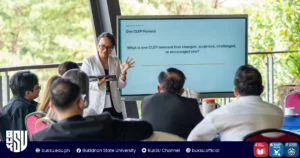
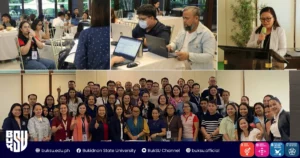
Institutional partnerships anchored on community needs and the values of legal education guide Bukidnon State University (BukSU) College of Law’s approach to its Clinical Legal Education Program (CLEP), Dean Atty. Ophelia Pilar E. Rubio-Zamora said during the 2nd Philippine Clinical Legal Education Program Summit in Baguio City.
Rubio-Zamora and Atty. Rosh R.K.B. Casulla represented the College of Law at the Access to Justice Summit, held October 6–8 at the Cordillera International Convention Hall, Baguio Country Club Road, Baguio City.
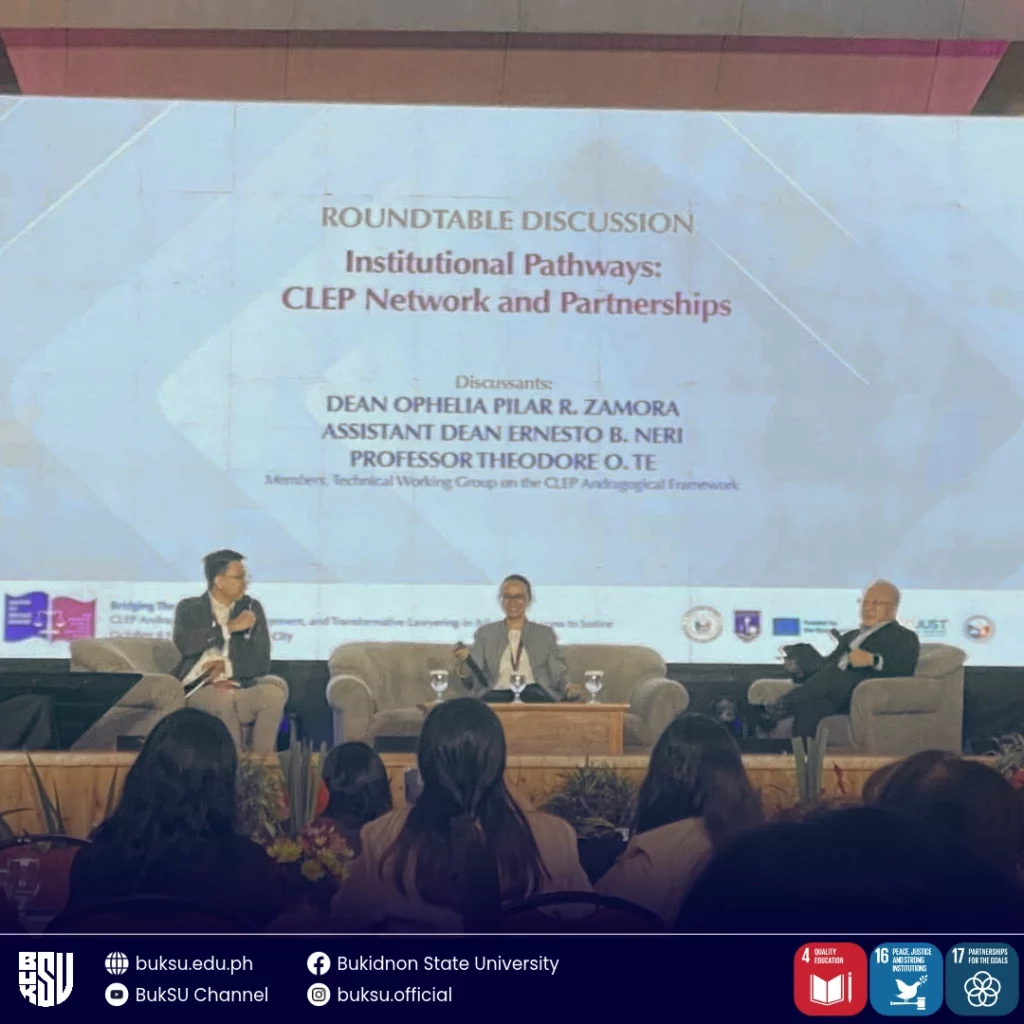
Rubio-Zamora joined a round-table discussion on “Institutional Pathways: CLEP Networks and Partnerships” on October 8, which examined how law schools can develop institutional relationships to support clinical legal education and access to justice.
Rubio-Zamora said law schools should identify their institutional values, educational objectives and communities’ justice needs before selecting partners.
“In our case, our partnerships have developed around our school’s core values of EPICC: Excellence, Professionalism, Integrity, Commitment, and Culture-sensitivity,” she said.
BukSU’s College of Law works with the local government unit on violence against women and children, the Commission on Human Rights on capacity-building for survivor-centered approaches to VAWC cases, The Asia Foundation and BALAOD MINDANAW on human rights, LENTE on voters’ rights education, and the Integrated Bar of the Philippines Bukidnon Chapter in providing supervising lawyers. The College of Law also works with Earth Justice on environmental rights.
Rubio-Zamora said these relationships serve purposes beyond providing students with exposure to legal practice. They also relate to the values and competencies the college seeks to develop among future lawyers.
“For a school that is just starting out, I would suggest starting small and being intentional,” she said. She advised law schools to begin with one or two partners whose work aligns with their institutional values, community legal needs and clinical program outcomes.
The discussion also addressed the need to make partnerships sustainable beyond the tenure of individual deans and other institutional leaders. Rubio-Zamora said agreements should establish shared goals, defined responsibilities, timelines, and monitoring and evaluation mechanisms.
“The evaluation part is especially important,” she said. “We ask not only, ‘Did we accomplish what we agreed to do?’ but also, ‘Does the community still need this, and are we actually responding to that need?’”
She said institutional partnerships should remain anchored on agreed goals and the continuing needs of the communities they serve.
Rubio-Zamora also discussed regional cooperation through the DUYOG Human Rights Hub, a network connecting law clinics and civil society organizations across Northern Mindanao, or Region X. She said members meet regularly to share challenges, discuss compliance concerns under the Unified Legal Aid Service (ULAS), and conduct capacity-building activities for law student practitioners and supervising lawyers.
When BukSU was establishing its clinic, Xavier University College of Law and BALAOD Mindanaw shared their experiences and practical advice, she said.
“The network also allows us to connect people with human rights concerns to the right organizations and resources,” Rubio-Zamora said. “So, we are able to extend our reach beyond what any single law clinic could accomplish on its own.”
Under Rule 138-A of the Rules of Court, CLEP allows law student practitioners to gain hands-on experience handling real cases and assisting actual clients under supervision. The program is a requirement for admission to the Bar.
The summit, convened by the Supreme Court’s Oversight Committee for the Implementation of Rule 138-A in collaboration with the Legal Education Board and the Philippine Association of Law Schools, with support from the European Union Governance in Justice Programme (EU-GOJUST), carried the theme “Bridging Theory and Practice: CLEP Andragogy, Judicial Engagement, and Transformative Lawyering in Advancing Access to Justice.”
The three-day gathering was attended members of the judiciary, law school deans, legal aid clinic directors, lawyers, externship partners and law student practitioners to discuss the nationwide implementation of clinical legal education and its role in access to justice. (BukSU – Information Unit)
Bukidnon State University (BukSU) has moved to modernize its regional operations through DASIG LINK (Digital Advocacy and Support for Information Governance – Library and Information
Bukidnon State University (BukSU) Research Ethics Committee (REC) has officially achieved Level 2 Accreditation from the Philippine Health Research Ethics Board (PHREB), expanding its mandate
Bukidnon State University (BukSU) and the Philippine Competition Commission (PCC) held a multisectoral forum to discuss competition policy and fair market practices on September 23,
Eighty-four faculty members and extension staff from Bukidnon State University (BukSU) completed a two-day training on the Harmonized Gender and Development Guidelines (HGDG) on October