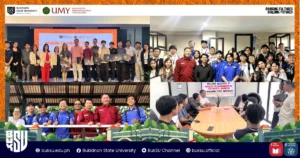
Bukidnon State University (BukSU) opened its 18-Day Campaign to End Violence Against Women (VAW) on November 25 with an integrated seminar on VAW prevention, gender equality, peace education and nonviolent learning.
The College of Arts and Sciences Gender and Development Unit (CAS GAD), College of Public Administration and Governance Gender and Development Unit (CPAG GAD), Center for Peace Studies (CPS), General Education Courses Department and Sociology and Social Science Department conducted the seminar at the BukSU Auditorium.
The BukSU Council of Peace Educators (BukSU-CPED) also participated in the activity, which gathered faculty members and administrative personnel from the university.
The seminar, titled “Empowering Safe, Gender-Responsive, and Peaceful Academic Communities,” was held in observance of the 18-Day Campaign to End VAW and the Mindanao Week of Peace.
The activity also coincided with the National Consciousness Day for the Elimination of Violence Against Women and Children.
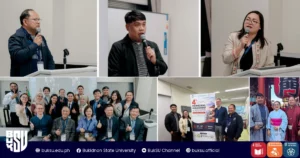
Dr. Jo B. Un served as a resource speaker for a session on women’s rights, VAWC prevention and gender-responsive academic communities.
Mr. Jan Daniel P. Ching handled a session on nonviolent learning and facilitation approaches in academic environments.
The seminar covered Republic Act No. 9262, or the Anti-Violence Against Women and Their Children Act of 2004, and Republic Act No. 9710, or the Magna Carta of Women. An open forum followed the sessions.
Ching’s presentation described nonviolent learning as an approach that considers compassion, mutual respect and shared authority in education.
“Non-violent learning is an educational paradigm rooted in compassion, mutual respect, and shared authority,” Ching said.
The presentation also discussed nonviolent facilitation as a method that uses empathetic listening, collaborative power and transparent communication in educational processes.
Jhanna Dawn B. Apal, head of the Center for Peace Studies, said the activity connects gender advocacy with peace education because gender-based violence affects human rights and sustainable peace.
“Recognizing that gender-based violence is both a human rights concern and a challenge to sustainable peace, this initiative brings together gender advocacy and peace education to promote safer, more inclusive, and conflict-sensitive academic environments,” Apal said.
Apal said the initiative also seeks to develop the capacity of educators, students and academic institutions to respond to violence and conflict through empathy, constructive dialogue and nonviolent approaches.
“As peace educators, we believe that peace must not only be taught; it must be practiced, demonstrated, and lived within our classrooms and communities,” she added.